How To Get Your Card in Oregon, USA. How To Get Your Card elsewhere in the USA, and around the World, also.

Resources in Oregon, USA; Clinics, Forums and Meetings and Meet-Ups, Biz and Orgs.
|
How To Get Your Card in Oregon, USA. How To Get Your Card elsewhere in the USA, and around the World, also. |
|
Resources in Oregon, USA; Clinics, Forums and Meetings and Meet-Ups, Biz and Orgs. |
|
 Information on OMMA
 Steps and Rules for The Process
Text of the OARS
More information on Cannabis as Medicine.
Professionals information.
Organizations and related info.
News Stories and Sources.
Articles of interest.
About this page
Bulletin Board for Posting info or give us ...
Feed Back on the subject or webpage.
Steps and Rules for The Process
Text of the OARS
More information on Cannabis as Medicine.
Professionals information.
Organizations and related info.
News Stories and Sources.
Articles of interest.
About this page
Bulletin Board for Posting info or give us ...
Feed Back on the subject or webpage.
 Cannabis and ...
 ADHD Attention Deficit / Hyperactivity Disorder
AIDS
Alzheimers
Anxiety
Arthritis
Asthma
Autism
Bipolar
Cancer
Cachexia
Crohns
Dementia
Depression
Diabetes
DIPG (Diffuse Intrinsic Pontine Glioma)
Epilepsy
Fibromyalgia
Glaucoma
Hypertension (High Blood Pressure)
Idiopathic Pulmonary Fibrosis (IPF)
Lupus
Multiple Sclerosis
Myasthenia Gravis
Nausea
Pain
Parkinson's
Pregnancy
PTSD (Post Traumatic Stress Disorder)
Seizures
Spasms
Tinnitus (Ringing in the Ears)
Tourettes Syndrome
CannaButter - a cannabis-infused medicinal application
Canna-Tea - Tea, a cannabis-infused medicinal application
Ticture - a cannabis-infused medicinal application
Canasol - a cannabis-based medicine
(RSO) - Rick Simpson Oil
(GHO) - Golden, Honey Oil
Tar (Resin)
Seeds - for Medical Cannabis and related info
Strains - of Medical Cannabis and related info
ADHD Attention Deficit / Hyperactivity Disorder
AIDS
Alzheimers
Anxiety
Arthritis
Asthma
Autism
Bipolar
Cancer
Cachexia
Crohns
Dementia
Depression
Diabetes
DIPG (Diffuse Intrinsic Pontine Glioma)
Epilepsy
Fibromyalgia
Glaucoma
Hypertension (High Blood Pressure)
Idiopathic Pulmonary Fibrosis (IPF)
Lupus
Multiple Sclerosis
Myasthenia Gravis
Nausea
Pain
Parkinson's
Pregnancy
PTSD (Post Traumatic Stress Disorder)
Seizures
Spasms
Tinnitus (Ringing in the Ears)
Tourettes Syndrome
CannaButter - a cannabis-infused medicinal application
Canna-Tea - Tea, a cannabis-infused medicinal application
Ticture - a cannabis-infused medicinal application
Canasol - a cannabis-based medicine
(RSO) - Rick Simpson Oil
(GHO) - Golden, Honey Oil
Tar (Resin)
Seeds - for Medical Cannabis and related info
Strains - of Medical Cannabis and related info
Search the Net with Excite!ment
|
|
Cannabis for ...
Doctors
Nurses
 Cannabis by ...
MERCY in America; Medical Cannabis in the USA
Alabama
 Alaska
Arizona
Arkansas
California
Colorado
Connecticut
Delaware
Florida
Georgia
Hawaii
Idaho
Illinois
Indiana
Iowa
Kansas
Kentucky
Louisiana
Maine
Maryland
Massachusetts
Michigan
Minnesota
Mississippi
Missouri
Montana
Nebraska
Nevada
New Hampshire
New Jersey
New Mexico
New York
North Carolina
North Dakota
Ohio
Oklahoma
Oregon
Pennsylvania
Rhode Island
South Carolina
South Dakota
Tennessee
Texas
Utah
Vermont
Virginia
Washington State
West Virginia
Wisconsin
Wyoming
Washington DC (District of Columbia)
The World of MERCY; Medical Cannabis around the Globe
Alaska
Arizona
Arkansas
California
Colorado
Connecticut
Delaware
Florida
Georgia
Hawaii
Idaho
Illinois
Indiana
Iowa
Kansas
Kentucky
Louisiana
Maine
Maryland
Massachusetts
Michigan
Minnesota
Mississippi
Missouri
Montana
Nebraska
Nevada
New Hampshire
New Jersey
New Mexico
New York
North Carolina
North Dakota
Ohio
Oklahoma
Oregon
Pennsylvania
Rhode Island
South Carolina
South Dakota
Tennessee
Texas
Utah
Vermont
Virginia
Washington State
West Virginia
Wisconsin
Wyoming
Washington DC (District of Columbia)
The World of MERCY; Medical Cannabis around the Globe
|
 ( skip to End ) |
( next ) |
more Info ...
|
( prev ) |
( go to Top )
( skip to End ) |
( next ) |
more Info ...
|
( prev ) |
( go to Top )

The Oregon Administrative Rules contain OARs filed through August 15, 2005, maintained by DEPARTMENT OF HUMAN SERVICES, PUBLIC HEALTH, covering DIVISION 8 - MEDICAL MARIJUANA333-008-0000 Description of the Oregon Medical Marijuana Act The Oregon Medical Marijuana Act was adopted by voters at the November 3, 1998 general election (Ballot Measure 67). The Act was amended by House bill 3052, passed during the 1999 legislative session. The text of the combined Act and HB 3052 is included in ORS 475.300 -- ORS 475.346. The Oregon Health Division was assigned rule-making authority necessary for the implementation and administration of the Oregon Medical Marijuana Act. The Act intends: (1) To allow Oregonians with debilitating medical conditions who may benefit from the medical use of marijuana to receive the benefit of their doctor's professional advice regarding the possible risks and benefits of medical marijuana; (2) To allow Oregonians suffering from debilitating medical conditions to use small amounts of marijuana without fear of civil or criminal penalties when their doctors advise that such use may provide a medical benefit to them; and (3) To make only those changes to existing Oregon laws that are necessary to protect patients and their doctors from criminal and civil penalties, and are not intended to change current civil and criminal laws governing the use of marijuana for non-medical purposes. Stat. Auth.: ORS 475.300 333-008-0010 Definitions For the purposes of OAR 333-008-0000 through 333-008-0090, the following definitions apply: (1) "Attending physician" means a physician who has established a physician/patient relationship with the patient, is licensed under ORS chapter 677, and who, with respect to a patient diagnosed with a debilitating medical condition: (a) Is primarily responsible for the care and treatment of the patient; (b) Is primarily responsible for providing medical specialty care and treatment of the patient as recognized by the American Board of Medical Specialties; (c) Has been asked to consult and treat the patient by the patient's primary care physician who is licensed under ORS Chapter 677, a Physician Assistant licensed under ORS Chapter 677, or a Nurse Practitioner licensed under ORS Chapter 678; or (d) Has reviewed a patient's medical records at the patient's request, has conducted a thorough physical examination of the patient, has provided or planned follow-up care, and has documented these activities in the patient's medical record. (2) "Debilitating medical condition" means: (a) Cancer, glaucoma, positive status for human immunodeficiency virus or acquired immune deficiency syndrome, agitation due to Alzheimer's disease, or treatment for these conditions; (b) A medical condition or treatment for a medical condition that produces, for a specific patient, one or more of the following: (i) Cachexia; (ii) Severe pain; (iii) Severe nausea; (iv) Seizures, including but not limited to seizures caused by epilepsy; or (v) Persistent muscle spasms, including but not limited to spasms caused by multiple sclerosis; or (c) Any other medical condition or treatment for a medical condition adopted by the Department by rule or approved by the Department pursuant to a petition submitted under OAR 333-008-0090. (3) "Delivery" means the actual, constructive or attempted transfer, other than by administering or dispensing, from one person to another of a controlled substance, whether or not there is an agency relationship. (4) "Department" means the Oregon Department of Human Services. (5) "Designated primary caregiver" means an individual eighteen years of age or older who has significant responsibility for managing the well-being of a person who has been diagnosed with a debilitating medical condition and who is designated as such on that person's application for a registry identification card or in other written notification to the Department. Designated primary caregiver" does not include the person's attending physician. Each patient may have only one designated primary caregiver at any given time. (6) "Marijuana" means all parts of the plant Cannabis family Moraceae, whether growing or not; the resin extracted from any part of the plant; and every compound, manufacture, salt, derivative, mixture, or preparation of the plant or its resin. It does not include the mature stalks of the plant, fiber produced from the stalks, oil or cake made from the seeds of the plant, any other compound, manufacture, salt, derivative, mixture, or preparation of the mature stalks (except the resin extracted there from), fiber, oil, or cake, or the sterilized seed of the plant which is incapable of germination. (7) "Mature plant" means the following: A marijuana plant shall be considered mature when male or female flower buds are readily observed on the plant by unaided visual examination. Until this sexual differentiation has taken place, a marijuana plant will be considered immature. (8) "Medical use of marijuana" means the production, possession, delivery, or administration of marijuana, or paraphernalia used to administer marijuana, as necessary for the exclusive benefit of a person to mitigate the symptoms or effects of his or her debilitating medical condition. (9) "New application" means an application defined under OAR 333-008-0020 signed, dated, and submitted by: (a) A new applicant to qualify for an initial registry identification card; (b) A patient after the patient's previous application has been denied or after the patient's registry identification card has been suspended; or (c) A patient after the expiration date of the patient's previously issued registry identification card. (10) "Oregon Health Plan" means the medical assistance program administered by the Department under ORS chapter 414. (11) "Parent or legal guardian" means the custodial parent or legal guardian with responsibility for health care decisions for the person under 18 years of age. (12) "Production" includes the manufacture, planting, cultivation, growing or harvesting of a controlled substance. (13) "Registry identification card" means a document issued by the Department that identifies a person authorized to engage in the medical use of marijuana and the person's designated primary caregiver, if any. (14) "Renewal application" means an application as defined under OAR 333-008-0040, signed, dated, and submitted by a patient within 3 months prior to the expiration date of the patient's current registry identification card and no later than the expiration date of that current card. Applications received after the expiration date of the patient's current registry identification card must meet all criteria for a "new application" under OAR 333-008-0010(9). (15) "Supplemental Security Income" means the monthly benefit assistance program administered by the federal government for persons who are age 65 or older, or blind, or disabled and who have limited income and financial resources. (16) "Usable marijuana" means the dried leaves and flowers of the plant Cannabis family Moraceae, and any mixture or preparation thereof, that are appropriate for medical use. "Usable marijuana" does not include the seeds, stalks and roots of the plant. (17) "Written documentation" means a statement signed and dated by the attending physician of a person diagnosed with a debilitating medical condition or copies of the person's relevant medical records, maintained in accordance with standard medical record practices. Stat. Auth.: ORS 475.005, ORS 677.010, ORS
475.302 & ORS 475.309(3) 333-008-0020 Registration Application and Verification (1) The Department shall create registration application forms and issue them to requesting physicians, applicants, or designated primary caregivers. (2) Except as provided in subsection (4) of this section, the Department shall issue a registry identification card to any person who pays a new or renewal application fee as set forth in subsections (2)(a) and (2)(b) of this section and who provides to the Department a completed application as set forth in subsections (2)(c) and (2)(d) of this section. (a) For the period January 1, 2005 through December 31, 2006, the following fees will be charged: $100 (fifty-five dollars) for a new application; $100 (fifty-five dollars) for a renewal application; or, $20 (twenty dollars) for either a new or renewal application by any patient who can demonstrate current eligibility in the Oregon Health Plan or who can demonstrate being a recipient of current Supplemental Security Income monthly benefits. (A) Eligibility in the Oregon Health Plan is demonstrated by providing a current, valid eligibility determination statement from the Department's Office of Medical Assistance Programs. To qualify for a reduced fee, a copy of the patient's current eligibility statement must be provided at the time the patient submits an application. The Department will verify the patient's Oregon Health Plan eligibility with the Office of Medical Assistance Programs. (B) Eligibility for Supplemental Security Income is demonstrated by providing a copy of a receipt of a current monthly benefit. To qualify for a reduced fee, a copy of a receipt of a current Supplemental Security Income monthly benefit must be provided at the time the patient submits an application. The Department will verify the patient's current Supplemental Security Income receipt of monthly benefits through the Department or with the Social Security Administration. (b) The Department will notify any patient who submits a reduced fee for which the patient is not eligible and will give the patient 14 days from the date of notice to pay the correct fee or to submit a current, valid eligibility determination statement for the Oregon Health Plan, or to submit a copy of a receipt for current Supplemental Security Income monthly benefit, as applicable. The Department will not suspend processing of the patient's application pending receipt of an eligibility statement. The Department will not grant application fee refunds for any eligibility determination made on or after the issue date of the patient's registry identification card. (c) To supply a completed application, the patient must provide to the Department either: (A) completed copies of all patient application, attending physician declaration, and parent/legal guardian (if applicable) forms; or (B) legible written statements that include all information required on the Department's forms. A copy of the relevant portions of the patient's medical record may serve as written documentation from the attending physician as long as it states that the patient has been diagnosed with a debilitating medical condition; the medical use of marijuana may mitigate the symptoms or effects of the patient's debilitating medical condition; and contains the physician's signature and the date the medical record was made. (d) In addition to the information required in ORS 475.309(2), the patient and the designated primary caregiver (if applicable) must provide a copy of current, legible photographic identification (i.e., Oregon driver's license, Oregon identification card, or Voter Registration card plus another current, legible photographic identification). The designated primary caregiver (if applicable) must also supply his or her address and date of birth. The patient must provide the Department with the address of the site where marijuana will be manufactured or produced, and indicate whether the property is under the control of the patient or the designated primary caregiver of the patient. (3) Optional information may be added to application forms at the discretion of the Department if such information serves the best interest of the patient and assists agencies in the implementation of the Act. Optional information need not be provided by the patient, attending physician, or designated primary caregiver, and failure to provide optional information ill have no bearing on the approval or denial of a registry identification card. (4) The Department shall issue a registry identification card to a person who is under eighteen years of age if the person submits the materials required under subsection (2) of this section, and one of the person's parents or legal guardians signs and has notarized a written declaration that states: (a) The person's attending physician has explained to the person and to one of the person's parents or legal guardians the possible risks and benefits of the medical use of marijuana; (b) The parent or legal guardian consents to the use of marijuana by the person for medical purposes; (c) The parent or legal guardian agrees to serve as the person's designated primary caregiver; and (d) The parent or legal guardian agrees to control the acquisition of marijuana and the dosage and frequency of use by the person. (5) The Department will verify information on all initial registration applications or written documentation. (a) The Department will contact each patient and designated primary caregiver (if appropriate) by telephone or by mail to confirm that the information provided is accurate. In cases where the patient is less than eighteen years old, the Department will also contact the parent or legal guardian to verify the information. In cases where proof of identity is uncertain, the Department may require a face-to-face meeting with the patient or designated primary caregiver and/or the production of additional identification materials for verification purposes. (b) The Department will verify with the Oregon Board of Medical Examiners that the attending physician is licensed to practice in the state and is in good standing. The Department will also contact each attending physician to confirm that the information provided is accurate and valid, and that the physician is an "attending physician" as defined by 333-008-0010(1). (6) Upon annual renewal of a registration application, the Department will verify all new information, but may use its discretion in determining the need to verify information that has not changed. Stat. Auth.: ORS 475.309, 475.312 &
475.316 333-008-0030 Registration Approval and Denial (1) The Department shall verify the information contained in an application submitted pursuant to this section and shall approve or deny an application within 30 days of receiving the fully completed application, including payment of the designated fee. (2) Once the Department has verified the information in a completed application, the Department shall issue a serially numbered registry identification card within five days. The registry identification card shall state: (a) The cardholder's name, address and date of birth; (b) The date of issuance and expiration date of the registry identification card; (c) The name and address of the person's designated primary caregiver, if any; and (d) Such other optional information as the Department may specify. (3) When the person to whom the Department has issued a registry identification card pursuant to this section has specified a designated primary caregiver, the Department shall issue an identification card to the designated primary caregiver. The designated primary caregiver's registry identification card shall contain the information provided in subsection (2)(a), (b), and (d) of this section. The designated primary caregiver's registry identification card shall also contain the patient's name and address. (4) In accordance with provisions of these rules, the Department has the authority to deny a registration application and to preclude a person from obtaining or using a registry identification card for a period of up to six months. (5) The Department may deny an application only for the following reasons: (a) The applicant did not provide the information required as provided in ORS 475.309; or (b) The Department determines that the information provided was falsified. (6) When the Department determines that an applicant does not qualify for a registry identification card, the Department shall send the applicant a denial letter within 30 days of receipt of the application or renewal application. The time periods set forth in subsection (9)(a) and (b) of this rule, that provide an applicant an opportunity to supplement an application that does not meet all of the requirements of ORS 475.309, do not count towards the 30-day time limitation for processing an application. The denial letter will be sent by certified, first-class mail to the address listed on the application form. The letter will state the reason for denial and the date at which another application may be submitted. (7) Denial of a registry identification card shall be considered a final Department action, subject to judicial review. Only the person whose application has been denied, or, in the case of a person under the age of eighteen years of age whose application has been denied, the person's parent or legal guardian shall have standing to contest the Department's action. (8) Any person whose application has been denied may not reapply for six months from the date of the denial, unless so authorized by the Department or a court of competent jurisdiction. (9) The Department will deny and return to the applicant a copy of the application including the application fee if either of the conditions below applies to the application: (a) The applicant did not provide all required information, and following a written request by the Department for the missing information, did not adequately respond within 14 days; or (b) Following an investigation by the Department, the Department has been unable to verify that the individual signing the application as the attending physician meets the definition under OAR 333-008-0010(1). The applicant will be allowed 30 days to submit written documentation and/or a new attending physician's declaration from a physician meeting the requirements of these rules. After that time, if no adequate response has been received, the application will be denied and returned. (c) Applicants whose application is denied under (a) or (b) above may re-apply for a registry identification card at any time. Stat. Auth.: ORS 475.309 & 475.316 333-008-0040 Annual Renewal and Interim Changes (1) A person who possesses a registry identification card shall register on an annual basis to maintain active registration status. (2) Between 30 and 45 calendar days prior to expiration, the Department shall mail notification to the patient's address of the upcoming expiration date. (a) The patient must submit, prior to the expiration, the following: (A) Written documentation to reconfirm the person's debilitating medical condition; (B) A copy of the patient's current, valid Oregon Health Plan eligibility determination statement or a copy of a receipt of the patient's current Supplemental Security Income monthly benefit, if applicable; (C) The name of the person's designated primary caregiver, if a primary caregiver has been designated for the upcoming year; and (D) Confirmation that existing application information has not changed. (b) If the application is not received by the expiration date, the patient's registry identification card and the designated primary caregiver's card (if applicable) will be deemed expired. The expiration date may be extended, due to personal hardship, at the discretion of the Department. (c) A patient must notify the Department within 30 working days of any change in his or her name, address, telephone number, attending physician, designated primary caregiver, or grow site. (d) A person who possesses a registry identification card pursuant to this section and who has been diagnosed by the person's attending physician as no longer having a debilitating medical condition shall return the registry identification card to the Department within seven calendar days of notification of the diagnosis. Any designated primary caregiver shall return his or her registry identification card within the same period of time. Stat. Auth.: ORS 475.309 & ORS 475.312 333-008-0050 Confidentiality (1) The Department shall create and maintain both paper and computer data files of the persons to whom the Department has issued registry identification cards. The data files will include all information collected on the application forms or equivalent information from other written documentation, plus registry identification card, date of issue and expiration date. Except as provided in subsection (2) of this section, the names and identifying information of persons to whom the Department has issued registry identification cards pursuant to ORS 475.309 and their designated primary caregivers, and the names and identifying information of pending applicants for such cards and their designated primary caregivers, shall be confidential and not subject to public disclosure. (2) Names and other identifying information made confidential under subsection (1) of this section may be released to: (a) Authorized employees of the Department as necessary to perform official duties of the Department, including the production of any reports of aggregate (i.e., non-identifying) data or statistics; and (b) Authorized employees of state or local law enforcement agencies when they provide a specific name or address. Information will be supplied only as necessary to verify that a person is a lawful possessor of a registry identification card, that a person is the designated primary caregiver of such a person, or to supply optional information provided on the application forms, or as provided in OAR 333-008-0060(2). (c) Other persons (such as, but not limited to, employers, lawyers, family members, other government officials) upon written request given by the registered patient or designated primary caregiver. Information will be supplied only as necessary to verify that a person is a lawful possessor of a registry identification card, that a person is the designated primary caregiver of such a person, or to supply other specific information provided, as requested in writing by the patient. Stat. Auth.: ORS 475.331 333-008-0060 Monitoring and Investigations (1) The Department may, at any time, contact a patient, designated primary caregiver, or attending physician by telephone, mail or in person to verify the current accuracy of information provided to the registration system. This authority does not extend to allowing Department staff to routinely search the person or property of a person who possesses a registry identification card or an attending physician. (2) Notwithstanding (1) above, the Department may, when it has reason to believe a violation of the conditions of registration exists, either conduct investigations to collect evidence of violations of the Oregon Medical Marijuana Act, or arrange for this responsibility to be assumed by the proper state or local authorities. Such violations include, but are not limited to: (a) A patient fails to notify the Department of any change in the patient's name, address, attending physician, or designated primary caregiver. (b) A patient or designated primary caregiver fails to return the registry identification card to the Department within seven calendar days of notification of the diagnosis that he or she no longer has a debilitating medical condition. (c) A patient, designated primary caregiver, or attending physician falsifies information during the registration or registration renewal process. (d) A patient or designated primary caregiver is convicted of a marijuana-related offense that occurred after the date of issuance of a registry identification card. (3) If the Department has reason to believe that an individual signing an application as the attending physician does not meet the definition of attending physician under these rules, the Department may examine the original patient medical record in the physician's possession or a copy provided by the physician. The sole purpose of this examination is to determine whether the physician meets the definition of OAR 333-008-0010(1) and does not include review of any clinical judgments such as adequacy of diagnosis or propriety of treatment. The Department will send written notification allowing the physician 10 days to provide additional information requested by the Department, a copy of the patient's medical record, or the original medical record for Department review. (4) In determining whether to examine a patient's medical record pursuant to subsection (3) of this section, the Department may consider, but is not limited to, factors such as complaints from patients or family members, complaints from health care providers, total number of applicants for whom the physician provided documentation, and/or number of applicants for whom the physician provided documentation during a specific time period. (5) In determining whether to examine a patient's medical record pursuant to subsection (3) the Department will notify the patient of the intent to review the medical records and request his or her authorization to conduct the review. A patient's failure to authorize a review of his or her medical records for investigation purposes may result in an incomplete application and the denial of the patient's registry identification card. (6) At any time, the attending physician may notify the Department that the patient's condition no longer warrants the use of medical marijuana. The Department shall then request that the physician notify the patient of the contact. (7) The Department shall refer criminal and/or medical practice complaints against patients, designated primary caregivers, or attending physicians to the appropriate state or local authorities. Stat. Auth.: ORS 475.309 333-008-0070 Suspensions (1) In accordance with provisions of these rules, the division has the authority to suspend a registration card. The division may preclude a person from using a registry identification card for a period of up to six months, at the discretion of the division. (2)(a) When the division proposes to suspend a registration card of a patient or a designated primary caregiver, the division shall send a notice of proposed suspension by certified and first class mail to person's address currently listed in the data file. (b) The notice shall contain the information required under ORS 183.415. (c) A registrant (patient or designated primary caregiver) may contest the proposed suspension of registration by submitting a request for a hearing in writing. The request for hearing shall be addressed to: State Health Officer, Oregon Health Division, 800 NE Oregon Street, Suite 925, Portland, OR 97232, and must be received within twenty-one (21) days of receipt of notice of the proposed action. (3)(a) When the Division obtains evidence that establishes that a registrant has committed egregious violations of the Act, including obtaining a registration card by fraud, committing multiple and/or continuing violations, or being convicted of a marijuana related offense, the Division may immediately deem the registration suspended. The Division will immediately attempt to notify the registrant by phone and will send written notification of the action by certified and first class mail within one working day. (b) The notification of immediate suspension will allow the registrant an opportunity to immediately request a hearing on the suspension. (c) The hearing will be conducted as soon as practicable and will be conducted under the provisions of ORS 183. (4) The division may, at its discretion, reinstate a registration card without re-application. However, if the registration card was obtained by fraudulent means, the Division may require the person to re-apply. Stat. Auth.: ORS 475.316 333-008-0080 Permissible Amounts of Medical Marijuana (1) A person who possesses a medical marijuana registry identification card issued pursuant to OAR 333-008-0030 may engage in, and a designated primary caregiver of such a person may assist in, the medical use of marijuana only as justified to mitigate the symptoms or effects of the person's debilitating medical condition. (2) A patient and a designated primary caregiver may not individually or collectively possess more than a total amount of one ounce of usable marijuana, if present at a location at which marijuana is not produced, including any residence associated with that location. (3) A patient and a designated primary caregiver may not individually or collectively possess more than a total of three mature marijuana plants, four immature marijuana plants, and one ounce of usable marijuana per each mature plant, if present at a location at which marijuana is produced, including any residence associated with that location. (4) If any individuals described in (1) possess, deliver, or produce marijuana in excess of the amounts allowed in (2) and (3), such individuals are not excepted from the criminal laws of the state but may establish an affirmative defense to such charges, by a preponderance of the evidence, that the greater amount is medically necessary to mitigate the symptoms or effects of the person's debilitating medical condition. Stat. Auth.: ORS 475.306 & 475.319(1)(c) 333-008-0090 Addition of Qualifying Diseases or Medical Conditions (1) The Department shall accept a written petition from any person requesting that a particular disease or condition be included among the diseases and conditions that qualify as debilitating medical conditions under section 333-008-0010(2) of these rules and be added to the list. (2) The Department shall, within 14 days of receipt of the petition, send a letter by first-class mail requesting the petitioner to provide if possible: (a) An explanation for why the condition should be included; (b) Any literature supporting the addition of the condition to the list; (c) Letters of support from physicians or other licensed health care professionals knowledgeable about the condition; and (d) Suggestions for potential expert panel members. (3) The State Public Health Officer or designee may make a final determination that a petition is frivolous and deny the petition without further review. (4) If the petition is not denied under (3) above, the Department shall appoint an expert panel of five to seven individuals to review a petition. The members of the panel shall include the State Public Health Officer or designee, other physicians licensed under ORS 677, at least one patient, at least one patient advocate, and other professionals knowledgeable about the condition being considered. (a) If the petitioner so desires, she or he shall be given the opportunity to address the panel in person or by telephone. (b) If the petitioner so desires, his or her confidentiality shall be strictly maintained. (5) The Department shall submit the written petition to the expert panel, which shall make recommendations to the Department regarding approval or denial. (a) The members of the panel may examine medical research pertaining to the petitioned condition, and may gather information (in person or in writing) from other parties knowledgeable about the condition being considered. (b) The panel members will submit individual recommendations to the State Public Health Officer, and the meetings of the panel will not be considered to be public hearings. (6) The Department will make a final determination on a petition within 180 days of receipt of the petition. (7) Denial of a petition shall be considered a final Department action subject to judicial review. (8) In cases where the condition in a person's petition is the same as, or is, as determined by the Department's State Public Health Officer, substantially equivalent to a condition that has already been denied in a previous determination, the Department may similarly deny the new petition unless new scientific research supporting the request is brought forward. Stat. Auth.: ORS 475.334 The official copy of an Oregon Administrative Rule is contained in the Administrative Order filed at the Archives Division, 800 Summer St. NE, Salem, Oregon 97310. Any discrepancies with the published version are satisfied in favor of the Administrative Order. The Oregon Administrative Rules and the Oregon Bulletin are copyrighted by the Oregon Secretary of State.
10. Organizations that have endorsed medical access to marijuana include: the
Institute of Medicine, the American Academy of Family Physicians; American Bar Association;
American Public Health Association; American Society of Addiction Medicine; AIDS Action Council;
British Medical Association; California Academy of Family Physicians; California Legislative Council
for Older Americans; California Medical Association;
California
Pharmacists Association; California Society of Addiction Medicine; California-Pacific Annual
Conference of the United Methodist Church; Consumer Reports
Magazine; Kaiser Permanente; Lymphoma Foundation of America; Multiple Sclerosis California
Action Network; National Association of Attorneys General; National Association of People with
AIDS; New England Journal of Medicine; and more, visit >> Patients Out of Time; visit:
www.medicalcannabis.com/Grouplist.htm
11. A few of the editorial boards that have endorsed medical access to marijuana
include: Boston Globe; Chicago Tribune; Miami Herald; New York Times; Orange County Register;
and USA Today.
12. Many organizations have favorable positions (e.g., unimpeded research) on
medical marijuana. These groups include: The Institute of Medicine, The American Cancer
Society; American Medical Association; Australian Commonwealth Department of Human
Services and Health; California Medical Association; Federation of American Scientists; Florida
Medical Association; and the National Academy of Sciences.
Visit: www.drugwarfacts.org/medicalm.htm for more.
Medical Professionals
The most significant evidence of marijuana’s acceptance by the medical community in the United
States consists of data on the number of physicians currently recommending marijuana medical use
by their patients:
"By any reasonable definition, marijuana has "currently accepted medical use in treatment in the
United States." Eight states have officially legalized its medical use. A minimum of
35,000 patients are currently using medical marijuana legally in these states. Over 2,500
different physicians have recommended it for use by their patients. As many as 5% of all
registered physicians have recommended marijuana in Oregon and Northern California. Usage
rates vary greatly among different regions. The average usage rate in the general population
ranges from 80 to 90 per 100,000 in California and Oregon, where there are numerous patient
support groups, to fewer than 10 per 100,000 in Colorado and Nevada, where cannabis medicine
is still underdeveloped. As many as 1% of the population in Mendocino County, California, are
legal medical marijuana users, while Canadian surveys suggest illegal medical usage as high as 2% -
4% in the general population. The widespread and growing popularity of medical marijuana and
its potential for treating a wide range of conditions indicate a growing role in American
medicine. These facts refute marijuana's current Schedule One misclassification as a drug
lacking "currently accepted medical use" ” (Gieringer 2002).
A considerable number of organizations representing health care professionals, the medical
community, and the general public support granting greater access to medical cannabis for
patients in need and recognizing explicitly marijuana’s medical use both in the United States
and in the international community.” See more at:
www.drugscience.org/amu/amu_medprof.htm
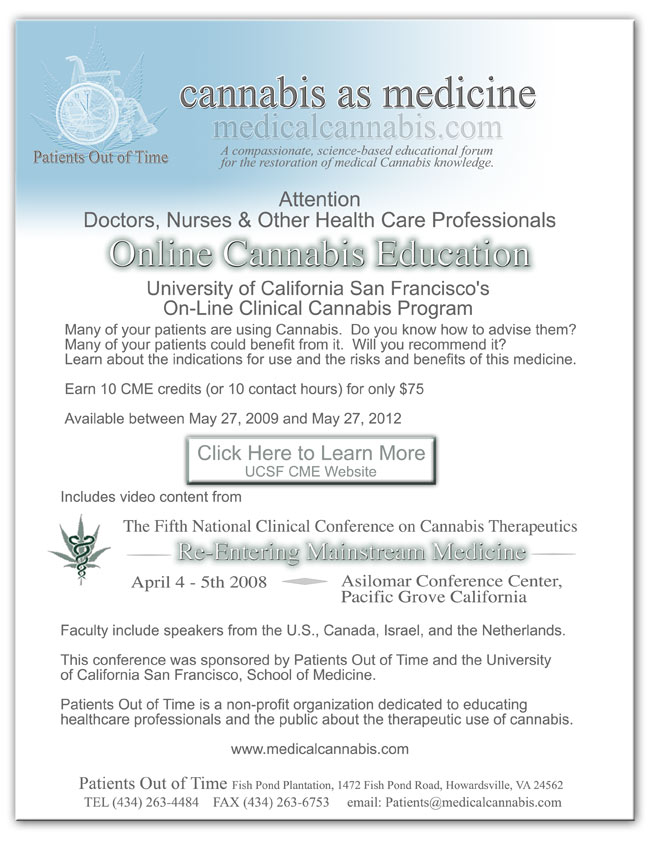
Medical Professionals Get Credits for
National Clinical Conference on Cannabis Therapeutics
Past educational credits for the work of this national group have been granted by The Colleges of
Nursing and Medicine of The University of Iowa, The Virginia Doctors Association, The University of
Virginia's Schools of Medicine, Nursing and Law, the Oregon Department of Human Services,
Health Services and the Oregon Doctors Association, among other conservative professional
health care organizations.
Patients' therapeutic cannabis use has always been supported by the academic and medical
communities, which have publicly in large numbers called for the immediate access to cannabis
under medical supervision," said Doctor Mathre. A list of such organizations can be found
at <www.medicalcannabis.com/>, or see below.
More information on the conference agenda, faculty, registration, and how to obtain Continuing
Education credits is available at:
www.medicalcannabis.com/conference.htm
This is one of the better articles on Sativex yet published. There are two other sparks that are
igniting interest in the medical cannabis debate.
"The Petition to Reschedule Cannabis" was submitted to the DEA in October of 2004. This
demand was forwarded with merit to their boss, the Department of Health and Human Services
in the fall of 2004 and has been under review by that organization since that time. This is a 60
plus page document that lists about 50,000 pages of worldwide research on the therapeutic use
of cannabis. The approval of this demand would end the war on cannabis. In a political sense the
Petition is every politicians dream. The announcement that research on cannabis has progressed
to the point that it can be returned to the National Pharmacopeia, will be accomplished by scientists,
and rescheduled by bureaucrats and not one elected official has to vote on the finding. Patients Out
of Time is a principal in that filing.
We think that the finding demanded by the Petition, that cannabis is medicine, is inevitable.
As we enter into the final months before our next and "Fourth National Conference on Cannabis
Therapeutics" we understand that medical conferences are boring and well off the vision of todays
media. This will be an accredited conference as has all in the series, meaning attendees who will be
medical doctors and registered Doctors in the main, will get professional education credits for their
attendance. Credit granted by such far out liberal institutions, such as previous education grantees,
the Medical College of the University of Iowa; the Oregon Department of Human Services, Health
Services; and the Pain Management Center, Department of Anesthesia, University of Virginia School
of Medicine. This means nothing I suppose to the layman but to the federal offices that are paid to
defile those that advocate for patient use of cannabis under medical supervision it is a chilling series
of forums. Conferences that the federals do not want you to know about or write about and
therefore never, ever discuss.
Maybe you should come to Santa Barbara next April to find out why. Please
see www.medicalcannabis.com for details and
contact information.
Sincerely,
Al Byrne, co-founder
Patients Out of Time is seeking a Registered Doctor willing to defend the federal
government’s position that cannabis (marijuana) has no medical value. After a year of
searching, Patients Out of Time has not found a single Doctor who disagrees with the American
Doctors Association (and thirteen other state nursing associations) position that cannabis is medicine
and who can scientifically disprove that position to an audience of peers. Visit:
www.medicalcannabis.com for more.
All research of information for this site has been undertaken by in-house consultants who are
registered Doctors. Doctors.info is fully owned and financially sponsored by Australian
Nursing Agency. Visit:
www.Doctors.info/medicine_cannabis.htm
For more information about ASA and the work they do, please see their website at
safeaccessnow.org or call 1-888-929-4367. visit:
safeaccessnow.org/downloads/cancer_brochure.pdf
In 1978 New Mexico lawmakers passed the first medical marijuana law, the Lynn Pierson Act,
named for a 26-year-old cancer patient. Currently the law allows marijuana to be used to relieve
nausea associated with chemotherapy and to ease eye pressure from glaucoma in connection with
a research project. More than 250 people used marijuana under the law until 1986, when lawmakers
ceased funding the program. Visit:
www.drugpolicy.org/library/factsheets/marijuana_newmex_factsheet_library.cfm
MEDICAL ESTABLISHMENT ABANDONS PATIENTS AND ETHICS: IS THERE A Nurse (OR Doctor) IN THE HOUSE?
Nursing is Caring
”Twenty years ago I began to learn what real suffering looks and feels like. I watched
helplessly while beautiful young men would, in three months time, age 50 years, dying from a disease
no one knew anything about at the time.
I have watched tobacco-cancer eat the lungs, livers and hearts out of people. They had no
idea, when they began using this legal herb, the consequences in store for them.
I've cared for all of these people because they were suffering, and because I am a Nurse.
Today I sadly witness another widespread - and preventable - tragedy of human suffering. It is
the pain of ill and dying people, legally persecuted for using an illegal herb, and simultaneously denied
their appropriate medicine by the medical establishment. This is the everyday experience of
cannabis patients, the "untouchables" of American medicine.
I've listened countless times as patients beg me to give them something I can't - permission to use,
grow, smoke, eat, and possess one simple herb. They ask me to tell a narcotics "task-force"
that they couldn't find their registry card, or explain to a doctor that the drug keeps them from
vomiting up their protease inhibitors.” Visit:
www.letfreedomgrow.com/articles/or020501.htm for more.
Federal Foolishness and Marijuana
Despite the desperation of these patients, within weeks after voters in Arizona and California
approved propositions allowing physicians in their states to prescribe marijuana for medical
indications, federal officials, including the President, the secretary of Health and Human Services, and
the attorney general sprang into action. At a news conference, Secretary Donna E. Shalala
gave an organ recital of the parts of the body that she asserted could be harmed by marijuana and
warned of the evils of its spreading use. Attorney General Janet Reno announced that
physicians in any state who prescribed the drug could lose the privilege of writing prescriptions, be
excluded from Medicare and Medicaid reimbursement, and even be prosecuted for a federal
crime. Visit:
www.sodaksafeaccess.org/endorsements.htm
Cannabis in Medical Practice; A Legal, Historical, and Pharmacological Overview of the Therapeutic Use of Marijuana
The legal dilemmas of the Cannabis prohibition are examined; patients, their pain, and their search
for legally provided medicine through the court system are presented; legal procedures and issues
related to medical use of marijuana are identified and explained. Attorneys and patients alike
will find the information invaluable. Visit:
www.druglibrary.org/olsen/medical/pot/book.html
Legal Medical Marijuana Patients, Proponents Speak Before American Nurses Association
Medical Use of Marihuana
|
|
MONALISA JOSEPH from monajos002@gmail.com wrote: " Hello, I am Monalisa. After being in relationship with my husband for years, he broke up with me. I did everything within my reach to bring him back but all was in vain, I wanted him back so badly because of the love I had for him, I begged him with everything, I made promises but he refused. I explained my problem to my friend and she suggested that I should rather contact a spell caster that could help me cast a spell to bring him back , I had no choice than to try it. I messaged the spell caster, and he assured me there was no problem and that everything will be okay before three days. He cast the spell and surprisingly on the second day, my husband called me. I was so surprised, I answered the call all he said was that he was so sorry for everything that had happened He wanted me to return to him. He also said he loved me so much. I was so happy and went to him that was how we started living together happily again. The spell casters email is : [dredesspellcaster@gmail.com]. You can email him if you need his assistance in your relationship or any other Case. DR. EDES SPELL CASTER could help you with the following: 1) Love Spells 2) Lost Love Spells 3) Divorce Spells 4) Marriage Spells 5) Binding Spell. 6) Breakup Spells 7) Banish a past Lover 8.) You want to be promoted in your office/ Lottery spell 9) want to satisfy your lover He also cure the below listed sickness; (1) HERPES, (2) DIABETES, (3) HIV&AIDS, (4) URINARY TRACT INFECTION, (5) HEPATITIS B, (6) IMPOTENCE, (7) BARENESS/INFERTILITY (8) DIARRHEA (9) ASTHMA... Contact this great man if you are having any problem for a lasting solution EMAIL ....dredesspellcaster@gmail.com/dredeshome@gmail.com Whatsapp him now ; +2348151937428 https://dredesherbal.webs.com https://monalisajoseph.blogspot.com "
Friday, May 29 at 11:58 PM:
Wednesday, April 17 at 05:20 AM:
Thursday, May 17 at 02:13 PM:
Thursday, January 18 at 12:37 PM:
Wednesday, May 10 at 05:15 PM:
Thursday, January 19 at 04:36 AM:
Sunday, September 25 at 02:09 PM:
Thursday, August 4 at 12:26 PM:
Tuesday, May 17 at 03:49 AM:
Wednesday, May 4 at 01:07 PM:
Sunday, May 1 at 04:03 PM:
Tuesday, April 26 at 08:49 AM:
Monday, March 7 at 09:30 AM:
Tuesday, December 29 at 09:38 PM:
Wednesday, June 10, 2015 at 07:30 PM:
Thursday, December 11, 2014 at 11:40 AM:
Tuesday, June 11, 2013 at 07:30 AM: -snip- I'm an unlikely advocate for marijuana legalization-a graduate from a top medical school with a Stanford M.B.A. I never personally liked marijuana and for much of my career judged it harshly. But my internal-medicine practice had become totally unworkable as a mother with two young kids with severe learning disabilities. Writing pot prescriptions was a job that fit neatly into my life. The medical-marijuana clinic where I worked was an upscale alternative to the rundown pot shops that had sprung up on the Venice boardwalk. The head of the clinic could have been my clone-another midcareer mother who couldn't make the modern practice of medicine work. Over time, as I heard my patients' histories, I became intrigued by their claims about the miraculous benefits of cannabis. So I read everything I could about medical marijuana. I felt like the discoverer of a new world already fully inhabited and thriving but totally unknown to the rest of us. Visit - http://www.thedailybeast.com/articles/2013/06/10/how-a-doctor-came-to-believe-in-medical-marijuana.html "
Friday, May 31, 2013 at 08:34 PM: -snip- Seventy-six percent of the 1,446 doctors who responded said they would give the woman a prescription for medical marijuana. -snip- "
Sunday, October 16, 2011 at 03:05 PM: The doctor group questions the medical value of pot and acknowledges some health risk from its use but urges it be regulated like alcohol. A law enforcement official harshly criticizes the new stance. visit - http://www.latimes.com/la-me-doctors-marijuana-20111016,0,179189.story "
Tuesday, July 29, 2009 at 08:43 PM:
Tuesday, July 29 at 08:41 PM:
Tuesday, July 29 at 08:35 PM:
Tuesday, July 29 at 08:33 PM:
Tuesday, July 29 at 08:32 PM:
Tuesday, July 29 at 08:30 PM:
Tuesday, July 29 at 08:30 PM:
Tuesday, July 29 at 07:57 PM:
|
( skip to End ) |
( next ) |
Give Us FeedBack
|
( prev ) |
( go to Top )
|